
 WEF Nexus Research Group
Jordan deals with climate and energy issues based on scientific systems
General Bulletin
Experts from foreign universities: Jordan deals with climate and energy issues based on scientific systems
AMMAN, July 18 (Petra) – Foreign experts said that Jordan has the human capabilities to deal with climate, energy, and environmental issues, and to link these issues to other fields, such as food and health, according to standards based on scientific foundations, and knowledge.
Speaking to Jordan News Agency (Petra) during the Climate, Environment and Health Conference organized by several international and local universities and organizations, the experts stressed that Jordan has clear strategies and plans for the diversity of water sources and increasing dependence on renewable energy, green finance, climate change and the environment.
The head of the Center for Environment and Respiratory Diseases in the Republic of Finland, Prof. Yoni Yakula, said that there is a great scientific ability in Jordan to identify all factors related to the environment and climate and their relationships to various diseases and impacts on food and water sources. There is also a serious focus by decision-makers toward finding solutions related to these issues. He added: “During our experience with Jordan, whether in the implementation of various projects or participation in conferences, we found that there is a serious relationship based on partnership between academics from universities and governments, in identifying the most prominent environmental challenges and formulating policies that address climate, health, water and energy issues.” Prof. Yakula stressed that Jordan is open to global partnerships with many countries and has clear plans to search for modern alternatives to energy and to face climate change through executive programs with high-capacity international organizations in these areas.
Professor Wael Al-Delaimi, Professor of Public Health at the University of California, San Diego, said that Jordan is well aware of its priorities in light of global climate variables and that water is a top priority because it is the most urgent need, pointing out that the indicators go in the direction of being able to face these challenges in innovative and scientific ways that focus on the results of studies and research conducted inside and outside Jordan. Al-Delaimi, who oversees several projects implemented in Jordan with funding from the US National Institute of Health, added that the climate, energy and food crisis is exacerbated at the global level, and here the role of Jordan in the Arab region is highlighted by virtue of its experience and possession of qualified human cadres capable of leading innovation and providing support to the Arab region. He pointed out that the projects currently implemented in Jordan are of great scientific feasibility and have a great role towards finding solutions to the risks that occur due to climate change, floods, water scarcity and their threat to human health, food security and the right to live in a safe environment that does not pose a source of danger to life.
Professor Rabih Mohtar, Professor of Food Security and Energy at Texas A&M University, said that Jordan is one of the leading countries in the region that sought to participate in the world’s search for appropriate solutions to face environmental and climate changes and to achieve food and water security, pointing out that this is reflected in the speeches of His Majesty King Abdullah II at global conferences: with a constant emphasis on sustainability, development, and the dedication of all energies and potentials to achieve effective water sustainability and search for alternative energy and conservation of resources.
Mohtar said that the specialists in Jordan have research, practical and intellectual capabilities that qualify them to attract international projects related to the sectors of water, energy, food security, and health and to provide appropriate solutions to address the problems and challenges at the local level of Jordan and the region in general.
— (Petra) Rakh/mq
18/07/2025 20:05:31
TAMU-EI & AUA create an MSc degree:
Sustainability of Agrifood Sector–WEF–Climate Nexus
The Texas A&M Energy Institute proudly announces a collaborative project with the Agricultural University of Athens (AUA) to directly confront pressing global challenges: a dual master’s program centered on the critical intersection of Water, Energy, Food (WEF), and Climate Change. This $3,000,000 project is generously supported by the Greek Ministry of Education’s “Internationalization of the Educational Services” of the Greek Higher Education Institutions program and is a testament to the pressing interconnected global challenges in the vital nexus of resource security and climate resilience. The partnership exemplifies the Energy Institute’s steadfast commitment to fostering international research and educational collaborations, and to addressing complex global issues. The program will leverage the interdisciplinary expertise of the Texas A&M University Department of Biological and Agricultural Engineering (BAEN), a pivotal contributor to this significant endeavor. This project is unique as the first formal WEF Nexus graduate program and builds on TAMU leadership in research and education.
Spearheading the effort are Dr. Rabi Mohtar, Senior Advisor for the Resource Nexus at TAMEI and Professor in Texas A&M’s Department of Biological and Agricultural Engineering (BAEN) and the Zachry Department of Civil and Environmental Engineering, and Dr. Konstantinos Pappas, Associate Director of Texas A&M Energy Institute (TAMEI), and Adjunct Professor in BAEN. Dr. Mohtar, an internationally recognized authority in the WEF Nexus, provided pivotal intellectual and strategic leadership in the proposal’s development. Dr. Pappas has extensive expertise in international policy and the intersection of sustainability and human mobility; his role in shaping the proposal vision and advancing the collaboration is pivotal through his leadership of the METAVASIS project. The dedicated leadership and shared visions of Dr. Rabi Mohtar and Dr. Konstantinos Pappas were instrumental in cultivating and strengthening the international partnership. Their unwavering commitment to fostering global collaboration and their forward-thinking approach to addressing critical global challenges within the WEF Nexus, have been pivotal in securing this crucial funding and driving the development of the master’s program. TAMEI’s dedicated team includes Dr. Stratos Pistikopoulos, Director of TAMEI and Distinguished Professor of Chemical Engineering, who will contribute his expertise to developing effective and sustainable technological and policy solutions within the complex WEF Nexus framework.
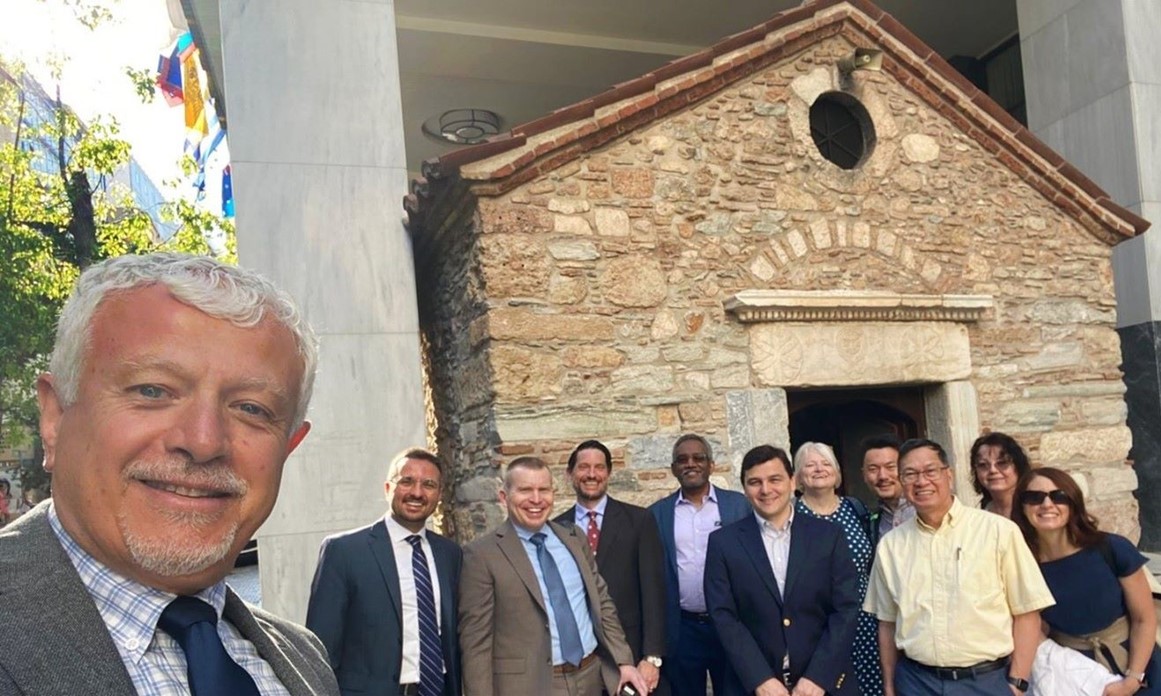
A delegation of Texas A&M University researchers visited Athens, Greece in June 2024 to initiate a dialogue on joint research and educational efforts, and to participate in the final METAVASIS workshop. The group is pictured outside a 16th-century church called “Ayìa Dynami.”
Dr. Patricia Smith, Head of BAEN, will guide the Texas A&M University (TAMU) team, co-directing activities with Dr. Thomas Bartzanas, Vice Rector of the Agricultural University of Athens (AUA). Dr. Amir Ibrahim, Associate Vice Chancellor for Research, College of Agriculture and Life Sciences, Associate Director and Chief Scientific Officer of Texas A&M AgriLife Research, and Professor in the Department of Soil and Crop Sciences, brings crucial agricultural insights to the nexus. Beyond these core experts, TAMU will harness the diverse knowledge and experience of its faculty, researchers, and administrative staff across numerous departments and colleges to ensure the comprehensive design and long-term impact of the interdisciplinary educational initiative. It is expected that the robust interdisciplinary collaboration between BAEN and TAMEI will create a truly unique and impactful program that will address the critical issues of water, energy, and food security and actively promote global sustainable development.
Strategic Initiative for Internationalizing Greek Higher Education
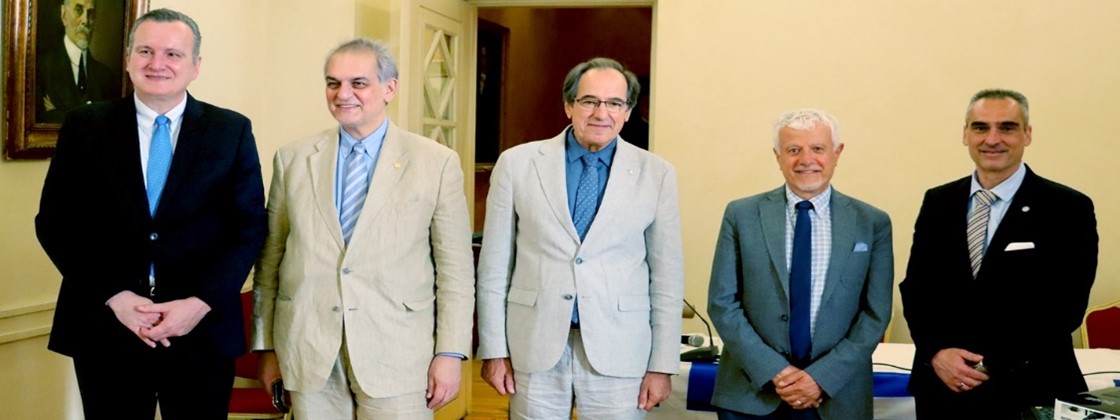
University leaders at the METAVASIS Workshop in Athens in June 2024. (L to R) Dr. Konstantinos Pappas, Dr. Spyros Kintzios, Dr. George Papadakis, Dr. Rabi Mohtar, and Dr. Thomas Bartzanas.
The Greek Ministry’s program aims to elevate Greek universities by supporting the development of joint or dual master’s programs with distinguished international partners. The selection of the AUA and Texas A&M University collaboration is significant, representing one of 63 funded proposals out of 132 evaluated by the Hellenic Authority for Higher Education (HAHE). This initiative signifies a commitment to innovative education and the cultivation of a new generation of scientists equipped to navigate the complexities of the modern world. Notably, fifteen U.S. universities are contributing to 21 of these funded proposals, including prominent institutions such as Yale University, Boston University, Columbia University, Georgetown University, Harvard University, and New York University, placing Texas A&M University within this esteemed group, involved in two projects, including this WEF Nexus and Climate Change Master’s program with AUA.
The “Sustainability of Agrifood Sector–Water–Energy–Food–Climate Nexus” Dual Master’s program: A Holistic Approach
The design phase of the two-year dual master’s program will kick off this summer at a workshop in AUA. The program, titled “Sustainability of Agrifood Sector–Water–Energy–Food–Climate Nexus,” builds upon the longstanding collaboration between AUA and Texas A&M University. Recognizing the urgent need for interdisciplinary knowledge, the program will educate future scientists to guide the implementation of sustainable strategies across businesses, public organizations, and research institutions.
The curriculum will integrate systems thinking with hands-on learning and applied research in critical areas such as:
- Sustainable food production in relation to water and energy resources
- Rational water use across agriculture and other sectors
- Energy challenges, energy systems, and technologies
- Climate change adaptation and risk assessment
- Sustainability analysis and nexus modeling
- Impacts of migration, conflict, and disaster on resource systems
The program will employ a dual master’s degree structure, requiring students to complete one year of study at each participating university.
Responding to Student and Faculty Demand
Agricultural University of Athens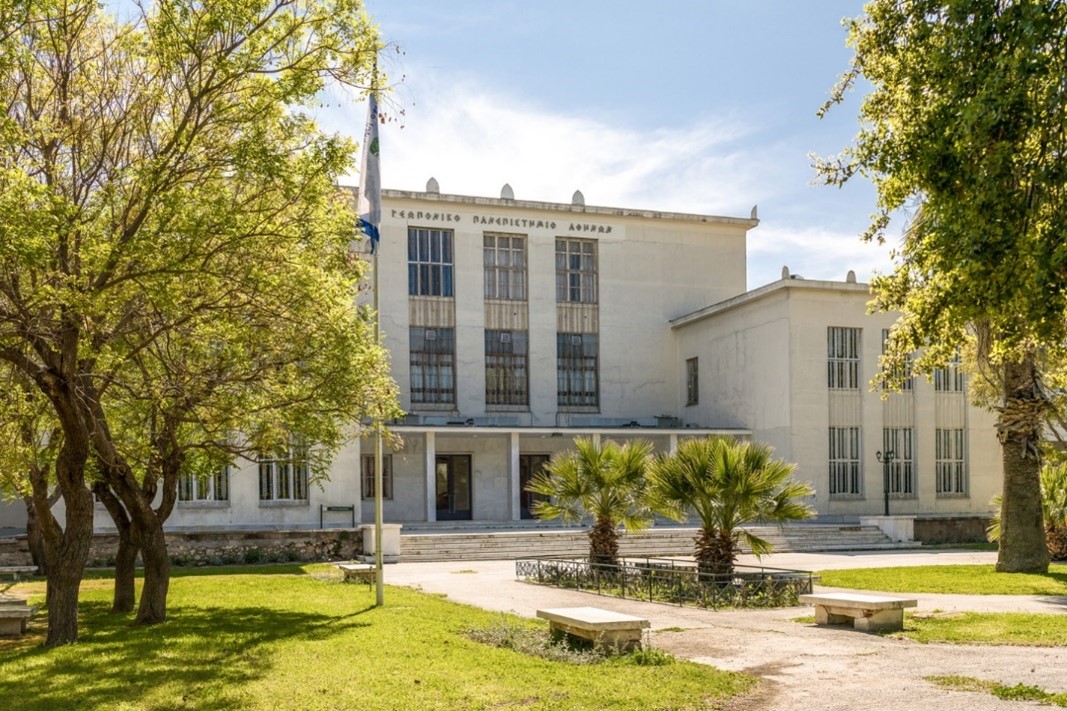
The decision to pursue a proposal for the design of a Master’s Program in this specific thematic area was carefully considered, taking into account the priorities outlined in the funding call, the strategic objectives of Texas A&M University, and the valuable insights from surveys conducted with students and faculty.
Comprehensive surveys were conducted to ensure the proposed program aligns with the needs and interests of both students and faculty, gathering valuable feedback from 51 students within BAEN and the Energy Institute’s educational program, as well as 17 faculty members from BAEN. Key findings included:
- Strong Student Interest: An overwhelming majority of students (86%) expressed significant interest in enrolling in a Master’s Program focused on the WEF Nexus offered in collaboration with a European University. Students emphasized the importance of practical applications, hands-on learning experiences, understanding career opportunities, and the program’s interdisciplinary nature.
- Faculty Support: Faculty members strongly supported the development of an international program centered on the WEF Nexus. They recognized the program’s benefit to students, equipping them with essential skills to address complex sustainability challenges. Faculty also advocated for integrating systems thinking, real-world applicability, emphasizing the program’s potential marketability, and collaboration with industry.
Similar findings were concluded in the survey analysis conducted by AUA.
Building a Collaborative Bridge: The METAVASIS Project – A Foundation for Collaboration
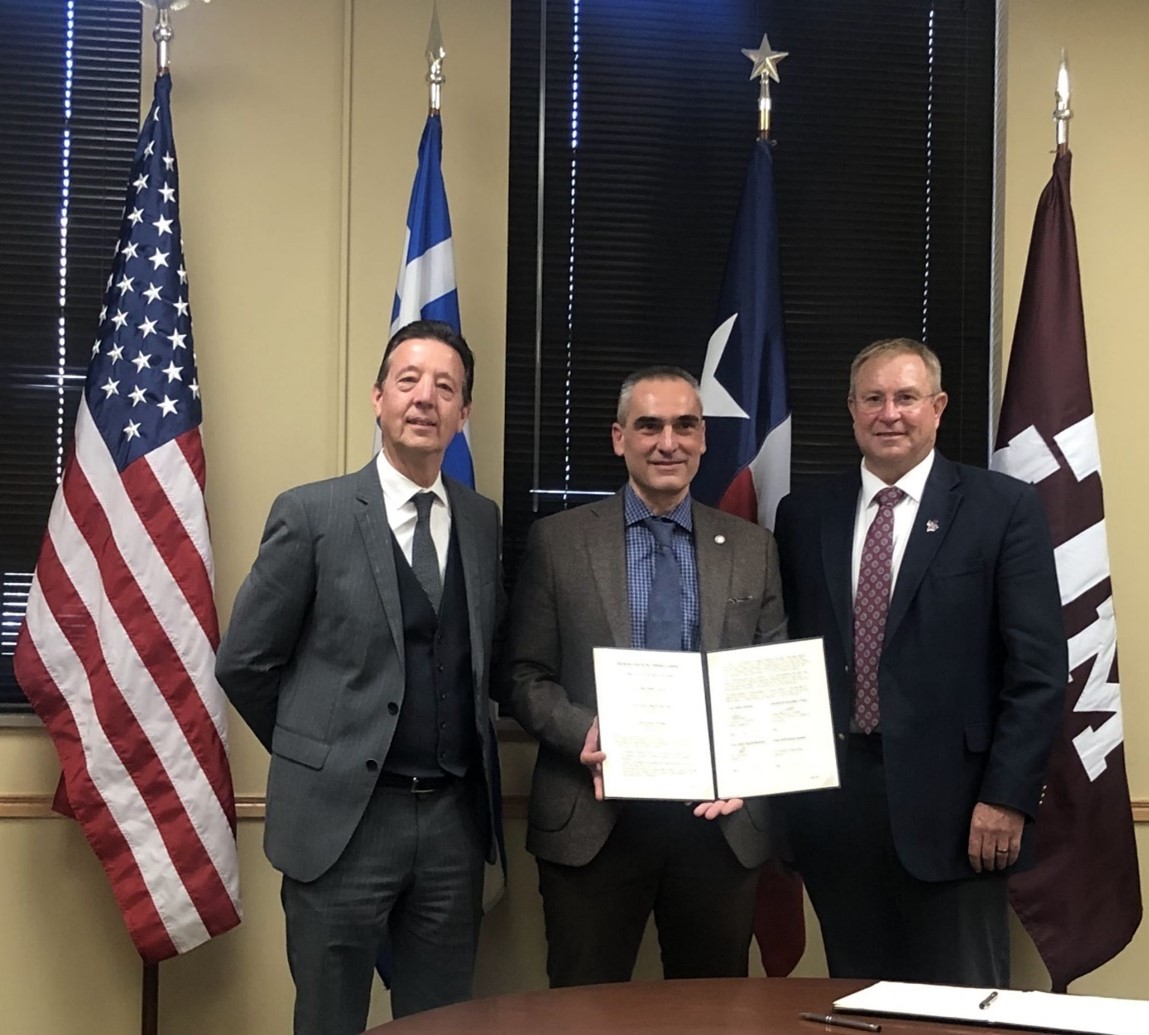
Signing of the Memorandum of Understanding between Texas A&M University and the Agricultural University of Athens: (from left) Prof. Stratos Pistikopoulos, Prof. Thomas Bartzanas, and Dr. Cliff Lamb.
The roots of the TAMU–AUA partnership were cultivated through the METAVASIS Project, led by Dr. Pappas, which explored the social impacts of energy challenges and laid the groundwork for broader collaboration. This initiative also facilitated academic exchange and revealed the shared institutional vision, which is now realized in the dual-degree program. A delegation of 14 faculty members from Texas A&M’s College of Agriculture and Life Sciences traveled to Athens, Greece, in June 2024 and engaged in fruitful discussions with Greek counterparts, fostering collaboration and identifying potential research and educational partnerships. Drs. Bartzanas and Ibrahim co-hosted the workshop, and both highlighted the fact that this landmark event had charted the course for an even deeper partnership between Texas A&M University and the Agricultural University of Athens. The formalization of the partnership through a comprehensive Memorandum of Understanding signed in February 2024 by Dr. Stratos Pistikopoulos, Dr. Thomas Bartzanas, and Dr. Cliff Lamb, Director of Texas A&M AgriLife Research, paved the way for joint educational and research initiatives. A subsequent Memorandum of Agreement signed in November 2024 further reflected the universities’ deep commitment to mutual goals in research, education, and global capacity building. These formal agreements underscore their shared vision for impactful international education, their deep commitment to collaborative endeavors, and their collective willingness to work synergistically towards common goals, providing a robust and reliable foundation for the successful development and implementation of this vital program.
Texas A&M University: A Legacy of Excellence
The development and implementation of this innovative dual master’s program will be a collaborative effort involving key units at Texas A&M University:
- The Department of Biological and Agricultural Engineering (BAEN): Uniquely positioned within both the College of Agriculture and Life Sciences (COALS) and the College of Engineering, BAEN’s interdisciplinary nature makes it ideally suited to co-lead the development and execution of this dual master’s program. The department’s faculty comprises internationally recognized experts in diverse fields, including water resources engineering, environmental engineering, bioenergy, food engineering, and sustainable agriculture—all crucial for a holistic understanding of the nexus.
- The Texas A&M Energy Institute: Founded 15 years ago, TAMEI fosters interdisciplinary collaboration to advance innovative energy technologies, study energy challenges, and inform energy policies. TAMEI has long been a global leader in systems-level approaches to unraveling the complex interdependencies within the WEF nexus, considering economic, legal, public policy, and environmental dimensions.
Shaping the Future: Program Aims
This newly funded project is strategically focused on designing and establishing a cutting-edge master’s program between AUA and Texas A&M University with the overarching aims to:
- Deliver specialized and advanced education in the critical and interconnected areas of the Water, Energy, Food Nexus and Climate Change, directly addressing the evolving needs of current and future industries and sectors.
- Provide students with an unparalleled international learning experience that uniquely combines the distinct strengths, diverse perspectives, and complementary expertise of both leading universities.
- Train a new generation of scientists, policymakers, and practitioners to lead in sustainability and resilience across sectors and borders
- Equip graduates with the essential knowledge, interdisciplinary skills, and global perspectives necessary to emerge as effective leaders and impactful innovators, empowered to tackle complex global challenges and contribute meaningfully to a more sustainable and resilient future for all.
Through this initiative, Texas A&M University and the Agricultural University of Athens reaffirm their leadership in addressing the world’s most pressing resource challenges—preparing students not only for the careers of the future, but for the stewardship of the planet.